- ai goodies ✨
- Posts
- will we still have (design) jobs in the future?
will we still have (design) jobs in the future?
the design role is being fundamentally transformed / here's what it's becoming, what's dying, and what you should do about it.

Ioana from AI Goodies
March 09, 2026
✋🏼 Before we get started, I need your help. AI Goodies is still a small, independent enterprise, and it needs your help to grow 🌱
so if you enjoy this read + my vibe, please share the article on your platform of choice, send it to friends, recommend others to subscribe ✔️
yay, thanks + let's get to it.
/
I asked two questions on Instagram recently. Simple question stickers, nothing fancy. Out of about 1,000 responses, the results shook me a little.
"Do you still see yourself as a UX/product designer three years from now?" → 48% said totally, why not. But 31% had doubts. And 20% were confident they're exiting this career. 😬
"Do you trust that the UX/product designer role will still exist in five years?" → only 23% said sure, why wouldn't it. 7% said no, this job is going to die. And 49% (basically half!) said: yes, but it will be transformed.
So the design industry right now is polarized, anxious, and uncertain. Half of us feel fine. The other half is somewhere between confused and terrified. And even the ones who feel fine mostly admit that a deep transformation is underway.
I want to add to that: it's going to be fundamentally transformed.
Anfisa and I just unpacked this on Honest UX Talks and I want to share the main ideas with you here, because I think this conversation is one of the most important ones we can have right now as a design community.
/
the ground is shaking (and that's not just a metaphor)
Let me ground this in what's actually happening. Anfisa opened our conversation by saying something really honest: she just left her job, she spent the weekend playing with Claude Code with her husband (who's an engineering manager), and she was processing the whole thing in real time. Her words: "I feel like our job is not gonna exist anymore. What are we doing? I'm in panic mode."
And I think many of us are in some version of that processing. It doesn't have to be panic. It can be confusion, curiosity, excitement, dread, or all of those things at once. But the feeling that the ground is shifting - that's real and it's shared.
Here's a quick walk down the timeline. In 2022–23, we were all going "whoa, you can really talk to this smart AI thing." New paradigm, cool. Then in 2024–25, the tool explosion happened. Vibe coding tools started competing aggressively for attention, Lovable flying people to Stockholm to hack together, Bolt throwing hackathons, everybody fighting for traction. As designers, we were in what I'd call the divergent stage of figuring out the tools. We explored, we adopted, we debated, we ran show-and-tell sessions with our communities that spilled from one hour into two and a half because nobody could stop sharing use cases.
But now, in 2026, something feels different. The tools are almost not even the point anymore. Because after playing with Claude Code and seeing what's possible, the real question isn't which tool do I use. The real question is: what will the outcome of my work even look like?
/
do we even need interfaces anymore?
Maybe sitting in front of a computer was never a good idea in the first place. Maybe we want presence, nature, life. And if systems can talk to each other through terminals, exchange data, give you just the text - do we actually need the visual layer anymore?
We had a real debate about this on the podcast. I pushed back. I believe there will still be some level of UI surface - something where you have control, where you can open, close, redo, navigate. Voice and conversation are becoming primary interaction modalities, yes. But I don't think interfaces disappear entirely. What I do think is that the interfaces of the future will be AI-generated. Adapted on the spot. A just-in-time interface / created by agents, personalized in real time, non-deterministic.
And that changes our role profoundly. But it doesn't erase it. If anything, it makes it more essential. Because someone has to define the conditions under which the right interface emerges. That someone is still a designer.
/
so what will we actually design?
Here's the question at the heart of everything: if AI generates the UI, and we're talking to large language models through conversation, what are we supposed to design?
The answer: we design how AI decides.
We are the ones designing the rules by which AI generates that on-the-spot interface. We give it the rules, the guidance, the quality standards, the aesthetics. We feed it information and guardrails to create that UI. And sure, it creates freely; but it's not that free → it's controlled by a designer.
The output of our work is probably not going to be screens anymore. Not mock-ups. Not Figma prototypes, because a Figma prototype is deterministic, one screen after the next. In reality, these AI-driven interactions are open-ended, they can go anywhere, and they're non-deterministic.
What we will be designing are protocols.
It might feel abstract, but if you've even started vibe coding, you already know what this feels like. You feed the system visual references, rules, prompts that say "don't do this, do that instead." You define tone of voice, aesthetic direction, behavioral constraints. We're already operating at some level with defining these protocols. We're just going to get much more of it, systemically, in our design roles.
/
the most powerful creative roles have always been curatorial
I've been sitting with a reframe that I think captures what's happening to us: we are becoming programmers of protocols and curators of experiences.
Not in the engineering sense. But in the sense that what we're really shaping now are the rules, the behaviors, the conditions under which AI systems interact with people.
And if that sounds abstract, consider this: the most powerful creative roles in history have always been curatorial. Film directors don't hold the camera. Architects don't lay the bricks. Editors don't write the words. They shape everything by deciding what stays.
So what are we curating, exactly? We're curating AI behavior. When it speaks. When it stays silent. How it fails. What it assumes about the person in front of it. We craft ethics with a visual layer. And designers are uniquely positioned for this because we've always been the ones translating between human needs and system capabilities. That hasn't changed. The system just got a lot more powerful.
/
what's changing in the day-to-day
If you're wondering what this means practically:
Less: pixel precision, layout from scratch, manual iteration.
More: prompt architecture, system constraints, quality judgment.
You're not drawing the thing. You're defining the conditions under which the right thing emerges. And that's not less design > it's design at a higher altitude.
The design process itself has changed. We used to follow: research → learn → build → iterate. Now it's more like: build → learn → iterate → rebuild. The pace is too fast to wait for perfect insights. It's less expensive to build now, so we start by building and learn through building. It's a fundamental shift from how we were trained — we were the ones always asking for more time, more discovery, more alignment. We're entering the age of: run with your best solution, improve it as you learn.
Anfisa made a point that stuck with me: in this new paradigm, speed might be the new perfection. Especially in early-stage product work, building and testing and iterating quickly matters more than perfecting mock-ups in Figma. That said, for products with longer histories and bigger codebases, Figma remains a critical source of truth. It's not either/or. It depends on context.
/
what about developers? what about us?
There's been a lot of talk about developer roles being vulnerable. Dario Amodei, CEO of Anthropic, recently published an essay called "The Adolescence of Technology" really worth reading. He mentions that between 70% and 90% of code at Anthropic is being written with Claude Code. So developers are vibe coding, but they're still developers.
The important thing: you still need critical thinking, system discernment, existing knowledge. I've seen people who don't know how to code get stuck very quickly with vibe coding. If you want to push the system forward, negotiate solutions, explore paths beyond what it recommends by default, you need to understand how technology works. Developers will still be needed. Their mode of operating is different, but their thinking skills and knowledge are what tell these systems if they're wrong.
The same logic applies to us. Designers are better positioned than many roles right now, in my opinion. We think in systems, we understand humans, we care about ethics and experience. But only if we invest in understanding the technology alongside our design thinking. You can't curate what you don't understand.
/
the skills that matter now
So if you want this future — if you like the idea of designing protocols and shaping how AI behaves — what do you actually need?
AI fluency. I used to say AI is just another thing in our toolbox. I now think it's the main thing. It's not optional. Get used to Figma with MCPs and plugins. Experiment with vibe coding tools; don't overthink which one. Just experiment.
Prompt engineering. Learn how to build clarity for these systems. Learn how to turn your design into code quickly. And then build real products. As many as you can. It's fun, it's empowering, and it's the fastest way to learn.
Expand your creative toolkit. This one is personal. I recently started creating animations with AI (see them below) something that would have taken me hours in After Effects, done in minutes. It genuinely felt like unlocking a new superpower. The tool I used? Replit. I recommend it as a playground for designers who want to build, prototype, and experiment beyond their usual tools. It's one of those environments where the gap between idea and thing just disappears. Try it here.
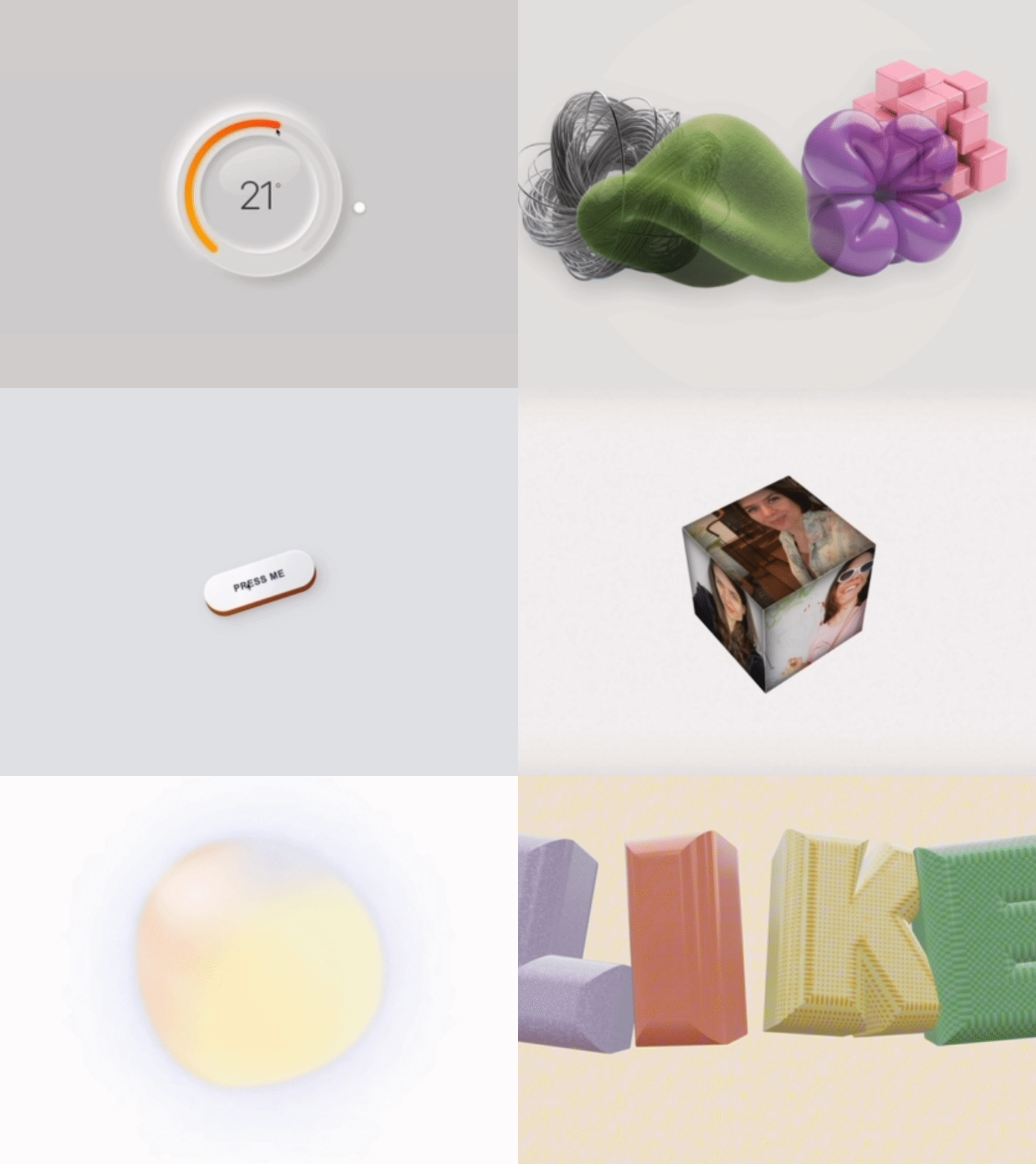
Conversational design. If computing is becoming conversational, then knowing how to design safe, trustworthy, transparent conversations is going to be critical. This includes things like explainability, tone, guardrails, and trust-building frameworks. Designers will have to deliver on this.
Critical thinking. Being able to judge well is something you earn through experience. And this is where things get tricky for junior designers — how do we onboard people who didn't have the luxury of learning through the same stages we did? The industry needs to have this conversation seriously.
Troubleshooting with AI. There's no excuse to get stuck anymore. Whenever you hit a wall, you have a smart entity at your fingertips. Maybe not always the best advice, but always a direction to try. Getting unstuck fast is itself a skill now.
Something I learned from designers at Intercom: they didn't know how to code, but because they started vibe coding in their Cursor environment, they learned front-end. Domingo, one of their designers, developed the skill as a consequence of experimenting. His skills didn't narrow → they expanded. You start vibe coding, and you force yourself into understanding what's going on and why something isn't working. It's this beautiful chicken-and-egg situation.
/
maybe we're just going back to "UX"
Anfisa said something I keep thinking about: maybe we're coming back to the original term. Not product design. Not UI design. Just UX: user experience. Because it doesn't specify the medium. It doesn't say screens. It says: the experience you thought through. In whatever form or shape.
And I think that's right. We've been through so many name changes (web designer, UI designer, UX designer, product designer). Maybe the cycle is bringing us back to the most honest, most medium-agnostic version: someone who thinks about the experience. Regardless of whether it's a screen, a conversation, a voice, or something we haven't invented yet.
/
the deciding vs. the making
This is the most important distinction for every designer reading this.
The designers who will struggle are the ones who defined themselves by the making. The ones who will thrive defined themselves by the deciding.
Making matters. Making is beautiful. Making is where craft lives. Making is what drew many of us to design. But if making is the only thing you identify with, if your professional worth is entirely tied to being the one who produces the artifact, then this moment will feel threatening.
Because AI can produce artifacts now. Not always good ones; but fast, and getting better.
What AI cannot do is decide. It cannot understand the full human context. It cannot feel the subtle wrongness of something that looks right but isn't. It cannot weigh ethical trade-offs with genuine care. It cannot bring taste, judgment, and cultural awareness to a problem the way a thoughtful designer can.
The deciding : that's where we live now. And it's a more powerful place to be.
/
and what about junior designers?
In every transformational moment (industrial revolution, internet revolution) there are always people who get on top of it early and benefit. And this might be one of those rare moments where junior designers can compete with senior ones by being proactive, early to AI, more creative, more willing to think differently.
Look at the portfolios today from recent graduates / extremely creative, challenging what design should look like. Some of them are landing in mature UX spaces without going through years of mediocre jobs first. That would have been unthinkable five years ago.
It's like any crisis: some people lose, some people gain. The key is to stay proactive and not ignore what's happening. If you're a junior designer reading this → the ground shaking is also the ground opening up.
/
so, will we still have jobs?
Yes. But not the same jobs.
We will design how AI decides. We'll write protocols, not mock-ups. We'll curate AI behavior: when it speaks, how it fails, what it assumes. We'll craft ethics with a visual layer. We'll think in systems, not screens. We'll build and learn through building.
Design has always moved toward orchestration as it matures. We went from hand-coding pages to design systems. From pixel-pushing to component libraries. Every evolution has been a move from manual execution to systematic thinking. AI just compressed the timeline. What used to take a decade happened in eighteen months. And that compression is what makes it feel scary instead of exciting. But the direction is the same direction design has always been going.
The designers who will make it are not the ones with all the AI tools listed in their bio. They're the ones who understand that design has always been about solving problems, and who are creative about how they solve them.
It's not a smaller version of design. It might be the biggest version of it we've ever had.
/
🎧 This article is based on a recent episode of Honest UX Talks with Anfisa and an IG carousel I published on the future of design roles. If you prefer listening, find the podcast wherever you get your pods.
📖 Recommended reading: Dario Amodei's essay "The Adolescence of Technology."
/
Will we still have jobs? I think so. But different ones, bigger ones, stranger ones. What do you think? Hit reply or drop your thoughts in the comments.
If you found this useful, share it with your friends or on a social media platform / whatever you want ❤️🔥

AI & Design Love,
hugs hugs,
Ioana 🪩